



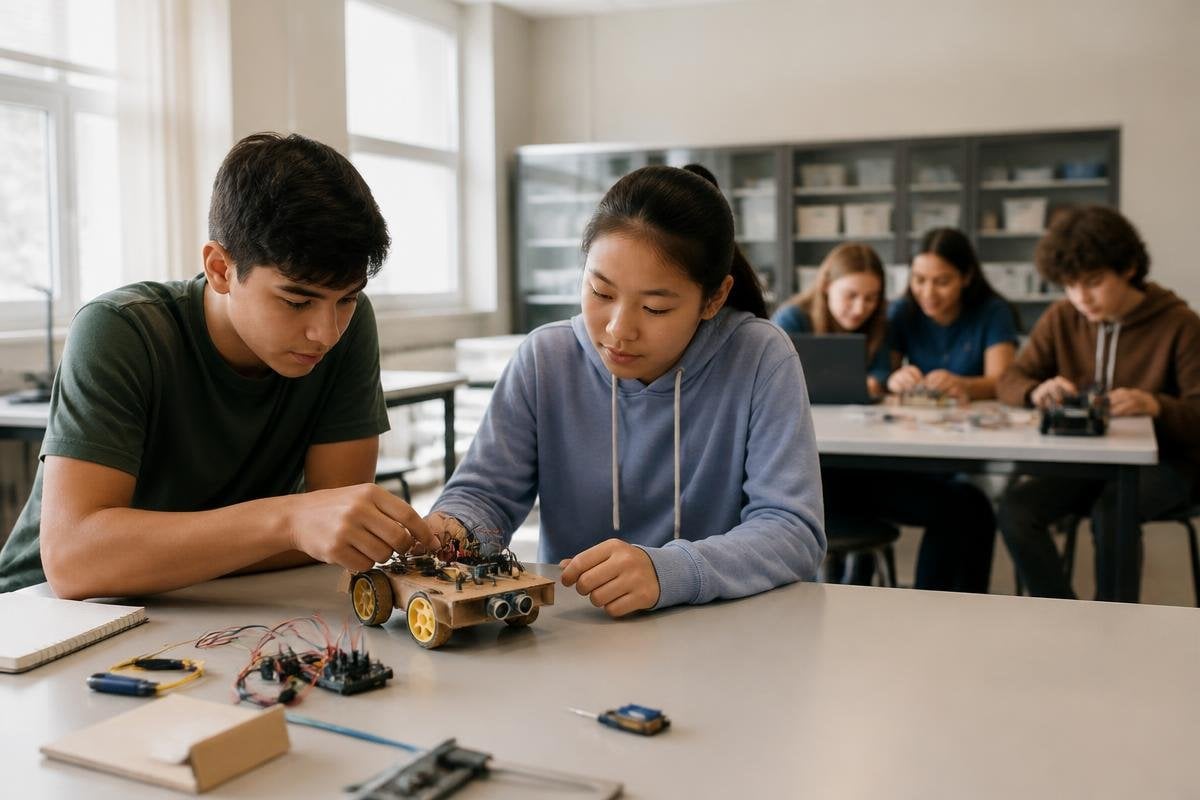
A robotics lesson can begin with cardboard, a small motor, or a computer screen. The real question is whether every student should learn how machines sense, decide, and move, even when a school cannot afford a full lab.
- Robotics links coding to physical results students can see.
- A useful course can start with low-cost parts and shared equipment.
- Good teaching matters more than the price of the robot.
What students learn from robotics
Robotics gives abstract lessons a physical result. A student changes a line of code, and a motor changes speed. They adjust a sensor, and the robot reacts to light, distance, or contact.
That loop helps connect maths, science, computing, and design. Students work with inputs, rules, power, movement, and failure in one task instead of meeting each subject as a separate block of work.
The lesson also has a clear test. A robot either follows the route, detects the object, or stops when the sensor sees an obstacle. The result gives students something they can inspect and fix.
This work suits different strengths. One student may write the control code. Another may draw the frame or check the wiring. A third may record the test and explain why the machine failed.
The class still needs clear roles, so group work does not become one student doing everything.
Why access matters
Robotics should reach students who may never join an after-school club. If schools leave it to optional activities, access can depend on free time, transport, family support, or the equipment available at home.
That does not mean every school needs humanoid robots or a dedicated workshop. A teacher can use simulation software, programmable boards, simple vehicles, or paper planning tasks before students touch hardware. The learning goal comes first, then the equipment follows.
Cost still matters. Hardware needs storage, charging, repairs, safe working space, and staff time. A school that buys a kit without planning those parts may end up with machines that sit in a cupboard.
Teacher preparation matters just as much. Staff need time to learn the platform, plan lessons, handle faults, and assess work fairly. A short training session may help someone start, but it cannot replace practice with the equipment.
Teachers can use Robot24.com’s reports on school robots to bring named machines, classroom tasks, and reported limits into lessons. Students then see how a kit on the desk connects to robots used at work.
What a good course should cover
A sound robotics course should give students a complete task, from the first plan to a tested result. It should also leave space for failure, because a machine that works once may still have a wiring fault, a weak battery, or code that breaks under a small change.
Students should read a sensor and explain its value, write a rule that links a condition to an action, and control a motor while checking speed and direction. They should also change the robot’s shape, weight, or grip for a stated task, then record what failed, what changed, and what happened next.
These tasks give teachers a way to judge learning without grading the most expensive machine in the room. A student can show strong reasoning with a basic platform, while another student can build a polished robot without understanding why it works.
A practical school decision guide
Before starting a robotics course, school leaders should check six points:
- Learning aim: name the skill students should show by the end of the unit.
- Staff time: assign someone to prepare lessons, maintain equipment, and help during tests.
- Access plan: decide how every student will get hands-on or simulated practice.
- Safety plan: set rules for batteries, moving parts, tools, and storage.
- Repair plan: record who replaces damaged parts and where spare parts come from.
- Review point: check student work before buying more equipment.
I’d make robotics part of a broad computing or design course before making every school build a dedicated lab. That route gives more students access while keeping the cost tied to teaching, rather than to a room full of unused hardware.
The useful test is whether students can explain what their machine sensed, why it acted, and how they improved the result. A school is teaching robotics when students can do that, whether the robot cost $50 or arrived in a large shipping crate.
